Python Automation & Optimization in PLAXIS 3D
- Oct, 24, 2026 - Oct, 27, 2026
- Webinar Data Management Numerical & Constitutive Modeling Visualization
- English
- Authored by: Geoengineer.org

Automation should not be used merely to make a model run faster. Its real value is to help engineers build repeatable workflows, investigate more alternatives, reduce avoidable manual errors and use finite-element modelling as a controlled engineering tool—not as a black box.
Beyond Software Operation
This 16-hour course has been developed to bridge the gap between Python programming and its practical application within PLAXIS 3D. We will not learn code for the sake of code. We will combine the required theory with guided practice, complete automation workflows and real engineering applications. The focus is on modelling strategy, engineering judgement, verification, interpretation of results and optimization—not software operation alone.
What You Will Learn
Build the Python foundation needed for engineering automation, including variables, loops, functions, classes and reusable logic.
Work with engineering libraries including NumPy, pandas, Matplotlib and openpyxl, and use PyQt6 to develop practical engineering interfaces.
Automate PLAXIS 3D workflows from connection and geometry creation to materials, loads, water conditions, meshing, staged calculations and results extraction.
Move from automation to optimisation through parametric studies, systematic model calibration and comparison between calculated and measured responses.
From Model Construction to Calibration
The course follows the sequence of an actual PLAXIS project. Participants will see how scripts can create and manage the model, run calculation phases, extract responses and organise results for engineering review. A practical optimisation project will demonstrate how soil stiffness parameters can be varied systematically, how PLAXIS results can be compared with measured pile-load-test data, and how the best-fit response can be identified based on a transparent error measure. This is where automation becomes an engineering decision-support process.
Who Should Attend
The course is intended for geotechnical and structural engineers, PLAXIS users, consultants, contractors, design offices, researchers and postgraduate students who want to move beyond repetitive manual modelling and develop more efficient, auditable and scalable analysis workflows. Familiarity with basic PLAXIS 3D modelling is recommended; the required Python foundation is introduced during the course.
What Is Included
Live, interactive and hands-on training over four consecutive days
Official Bentley Systems certificate confirming 16 training hours
Individual access to the latest PLAXIS Ultimate licence during the course
Full session recordings, practical applications and dedicated Q&A
Register Early. Seats are limited, with promotional discounts available for early registration and group enrolment. If you want to convert PLAXIS 3D from a manual modelling environment into a repeatable automation and optimisation platform, this course is designed for you.
Want to read more like this?

Online Training on Plaxis Automation Part I: Efficient automation workflow and introduction to Python Scripting
Sep, 30, 2019 | EventModelling complex geotechnical problems in a Finite Element program can be challenging and represen...

Istanbul In-Person Training | PLAXIS Automation for Excavations
Jul, 03, 2026 | EventJoin us in this instructor-led course to learn about PLAXIS automation for excavations.September 21:...
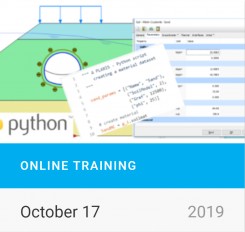
Online Training on Plaxis Automation Part II: Advanced Features and Practical Examples of Python Scripting
Oct, 01, 2019 | EventAfter the introduction to Python scripting in part I, this second session will demonstrate more adv...

Online Training on Plaxis Automation Part III: Result Post-Processing Automation in PLAXIS Output
Oct, 01, 2019 | EventThis online training is the final part of the series Plaxis Automation Online Trainings will be fo...

Plaxis 2D/3D Basic Course – Online Training
Apr, 27, 2026 | EventJoin us for a 3-day PLAXIS 2D and a 3-day PLAXIS 3D interactive training course hosted by Geoenginee...
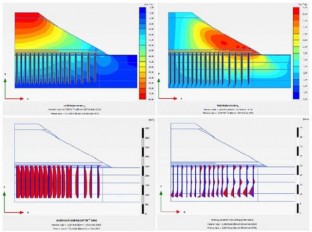
Optimizing Soil Improvement with PLAXIS: Techniques and Benefits
Nov, 12, 2024 | NewsSoil improvement refers to the process of modifying the physical properties of soil to improve its...

How the Past 30 Years of PLAXIS History Pave the Way for a Promising Future
Oct, 05, 2023 | NewsOver the last 30 years, PLAXIS innovation has driven the geotechnical analysis industry, enabling e...
PLAXIS Advanced Course on Computational Geotechnics | In-Person
Aug, 20, 2025 | EventThe well-established Advanced Course on Computational Geotechnics for experienced PLAXIS users is o...
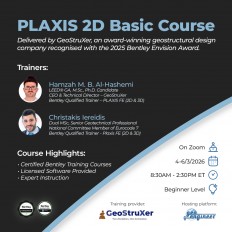
Plaxis 2D Basic Course – Online Training (18 hours)
Feb, 11, 2026 | EventJoin us for this 3-day PLAXIS 2D training course hosted by Geoengineer.org and delivered by GeoStru...
On This Day
September 16th 2015
READ MORE
Related Video

Trending


Piling & Ground Improvement Conference 2026 (DFI-PFSF)
Slope stability using PLAXIS and GeoStudio | In-Person Workshop