100,000 tonnes excavated as HS2 completes Old Oak Common tunnel connection.

HS2 has completed the twin mined tunnel connections between the Victoria Road crossover box and Old Oak Common station in west London, creating a continuous underground link between the future station and the West Ruislip tunnel portal.
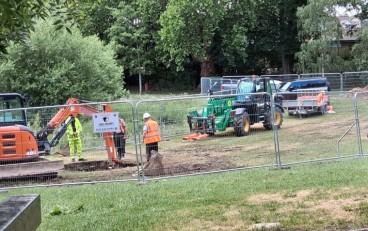
The two tunnels are each approximately 360 m long and were excavated through London Clay using conventional tunnel excavators rather than tunnel boring machines. Excavation began from the Victoria Road crossover box in May 2024, with around 100,000 tonnes of material removed during the works, all of which has been taken to reuse projects in the UK.
The construction method was selected because the tunnel geometry changes significantly between the crossover box and the station. Each tunnel narrows from a width capable of accommodating two tracks to a single-track profile, making conventional mined excavation better suited to the changing cross-section.
Following excavation, the tunnels were initially supported using sprayed concrete, with approximately 30,000 m3 applied during construction. A permanent cast in situ concrete lining was then installed using travelling formwork.
The latest breakthrough into the station box, marked by a visit from Rail Minister Lord Hendy, followed completion of the northbound connection on 13 October and created a continuous 8.8 mile, or 14.2 km, underground route from Old Oak Common to the West Ruislip portal on London's northwestern edge.
A distinctive method was used for the final breakthroughs into the station box. Rather than demolishing the separating wall conventionally, the dividing wall was cut into blocks and pushed Jenga-style from the station side back into the completed tunnel behind, allowing them to be removed in a controlled sequence.
The approach had not previously been used elsewhere on HS2 and was adapted to the confined geometry around the station interface. David Hannon, Operations Managing Director at contractor Skanska Costain STRABAG, described the breakthrough as a significant milestone and credited the teamwork of those working underground and on the surface.
Old Oak Common is being developed as a major transport interchange where HS2 will connect with the Elizabeth line, Great Western Railway and Heathrow Express. Once operational, the high-speed railway is planned to connect the station with Birmingham Curzon Street, around 140 miles away, in approximately 45 minutes, more than doubling peak-time seat capacity between the two cities.
The tunnelling milestone comes after completion of the deep-bore tunnel drives between London and Birmingham, while more than 80% of the route's major structures are now either under construction or complete. HS2 chief executive Mark Wild said the programme is in the final stages of a fundamental reset intended to deliver the line between London and the West Midlands at the lowest reasonable cost, with the ambition of running from Old Oak Common to Curzon Street by 2037 or earlier.

Separate tunnelling works are continuing east of Old Oak Common. Two TBMs launched from the eastern end of the station box at the start of 2026 are progressing on 4.5 mile drives towards the future Euston terminus, with arrival expected in mid-2027.
The completed mined tunnels represent an important interface between the long bored sections of HS2 and the Old Oak Common station structure. Their construction also illustrates how tunnelling methods can be adapted when geometry, access and station interfaces make a standard TBM solution less suitable.
Sources: mediacentre.hs2.org.uk/, tunnellingjournal.com, railadvent.co.uk
Want to read more like this story?

New crustal stress map of North America
Apr, 23, 2020 | NewsA new study presents the first quantitative stress magnitude map that also includes horizontal stre...

Using Terzaghi’s Equation in Foundation Design
Nov, 25, 2022 | NewsTheoretical models to predict the capacity of helical piles are based on Soil Mechanics and an appr...

Parameters Variation: Model Customization and Sensitivity Analyses
Sep, 15, 2021 | NewsA well-known engineering challenge in the framework of finite element (FE) analysis-based design is...

Repair of massive 50-meter sinkhole in Bangkok enters new challenge after structural breach
Sep, 26, 2025 | NewsIn the early hours of September 26, emergency efforts to stabilize the massive sinkhole in front of...
UK geothermal projects expand from Cornwall power to Birmingham heating
Apr, 16, 2026 | NewsThe United Kingdom is advancing geothermal energy development through a combination of deep geotherm...
Seven Frequently Asked Questions about Helical Piles
Apr, 29, 2026 | NewsHelical piles are a proven deep foundation solution used across commercial, industrial, utility, and...

Block caving: A new mining method arises
Jul, 25, 2018 | NewsBlock caving is a new alternative method of developing new mines or extending the operation of open...

Categories of isolated foundation footings
Jun, 25, 2019 | NewsThe foundation of a building is constructed in order to transfer the superstructure's load to the g...
Maharashtra's longest road tunnel to be completed soon
Oct, 17, 2022 | NewsMaharashtra's longest road tunnel between Igatpuri and Kasara is nearing completion. It is built as...
On This Day
November 10th 1990
READ MORE
Related Video

Trending

Alert level is raised in Mexico as the Popocatépetl volcano spews ash and gas

Embankment Collapse on NH-66 in Kooriyad Triggers Engineering and Oversight Review

Fehmarnbelt tunnel advances with first element ready for immersion

Geotechnical Engineering 2032 Boom: Trends, Challenges, and Emerging Opportunities

Deadly mining landslide in Central African Republic raises safety concerns