3D PLAXIS Model Validates 2D Design for Geosynthetic-Encased Stone Columns Beneath Bavarian Roundabout
A three-dimensional PLAXIS finite element model has been used to verify and cross-check a two-dimensional design for geosynthetic-encased stone columns supporting a new roundabout on soft peat in Bavaria, Germany, according to a paper presented at the 21st International Conference on Soil Mechanics and Geotechnical Engineering (ICSMGE 2026) in Vienna.
The paper, authored by Grace Stapley, Beatrice Beker and Frank Remmert of ILF Consulting Engineers Austria GmbH, examines the detailed design of ground improvement measures for a roundabout forming part of the new federal state road B2 near Eschenlohe, Bavaria. The site is underlain by a 6.5-8.0 m thick layer of very soft peat, overlying alternating gravelly and cohesive valley fill deposits, conditions the authors describe as 'particularly poor.' To manage settlement and consolidation, the design combines preloading with a surcharge embankment and geosynthetic-encased stone columns.
Two Models, One Design Problem
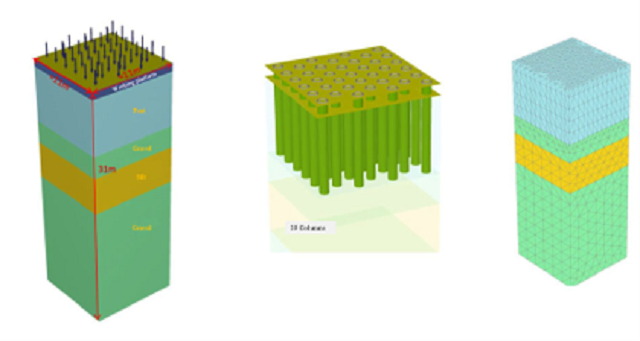
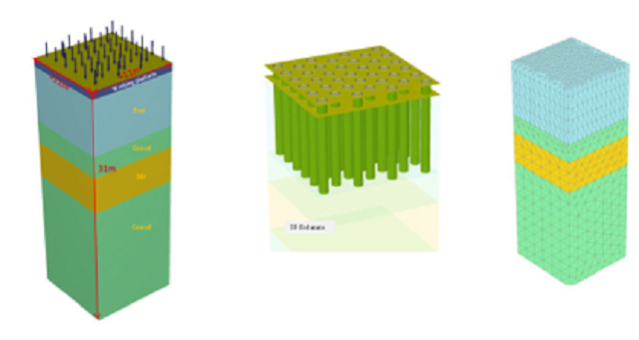
Because a conventional two-dimensional, plane-strain PLAXIS model cannot directly represent the three-dimensional stabilising effect of the geosynthetic encasement around each stone column, the design team built two complementary PLAXIS models. A 2D PLAXIS model reproduced the roundabout's exact geometry across two critical cross-sections, referred to as QP KV1 and QP KV3. In parallel, a 3D PLAXIS model was built covering a representative 11 m x 11 m segment of the embankment, centred on a single column and including 39 columns with their surrounding soil, working platform and two horizontal geogrid reinforcement layers.
What the 3D Model Showed
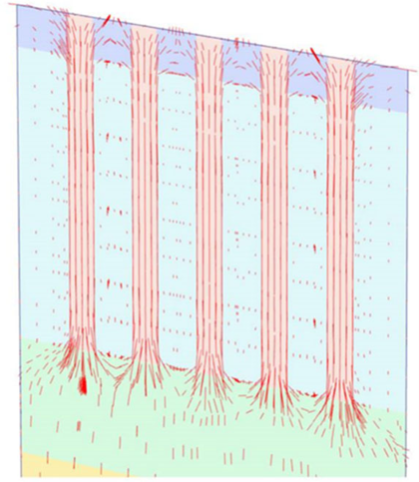
According to the results, the 3D PLAXIS model predicted a settlement of 22.0 cm due to the overload fill, evaluated at the centre of the model (results at the model edges were excluded as unrepresentative). The model showed that the applied load was almost completely redistributed onto the stone columns, with the surrounding soft peat carrying almost no additional weight. This redistribution is illustrated by the 3D model's stress output in the main stress direction, in which load-induced stresses are shown concentrated above the columns, a pattern the authors report corresponds closely with the theoretical distribution set out in the EBGEO design guideline.
The paper reports that comparing the mobilised effective vertical stress between the 3D model and a simplified 2D model, built using the equivalent-cohesion approach, showed a similar stress mobilised at the column in both cases. This comparison allowed the team to adopt an equivalent cohesion value of 90 kPa for the encased columns in subsequent 2D calculations, and confirmed that the load-bearing behaviour of the column was comparable between the 2D plane-strain representation and the more detailed 3D geometry.
Where PLAXIS Results Stopped and Analytical Methods Took Over
The authors are explicit about the boundary between numerical and analytical methods in the design. Per the EBGEO guideline, the design of the geosynthetic reinforcement cannot be based on numerical results alone, so the ring forces in the encased columns and the forces on the horizontal reinforcement were instead calculated using EBGEO's analytical methods. Creep settlements, which the PLAXIS models do not represent, were likewise determined analytically rather than numerically, and the paper notes that up to 12 cm of creep settlement is still expected over five years even with the encased columns in place, against an estimated 24 cm without them.
On settlement predictions, the 2D model results for the two critical cross-sections showed a maximum settlement of 13.8 cm at QP KV1 and 8.8 cm at QP KV3 in the newly constructed embankment fill, with short remaining consolidation times of two days and one day, respectively. The paper concludes that the settlement predictions from the 3D model validate the 2D model's results, which the authors state enhances the reliability of the consolidation-behaviour assessment and verifies the assumptions carried into the detailed design phase.
The authors recommend continuous settlement monitoring during construction and note that pre-loading the peat to an over-consolidated state could further reduce creep settlement, alongside the monitoring programme already proposed for the consolidation of the completed roundabout.
Want to read more like this story?

An Overview of Column-Based Soil Improvement Modelling with PLAXIS
Feb, 16, 2025 | NewsSoil improvement is a critical process in geotechnical engineering, aimed at modifying soil proper...

Why Run PLAXIS 3D Analysis?
Jun, 07, 2021 | NewsMost geotechnical engineers use FEA software packages for their geotechnical design. It is especial...

Numerical Modelling: On the Importance of an Appropriate Soil Model
Jul, 22, 2021 | EducationThe following was prepared by Dr. Ronald B.J. Brinkgreve, and first presented by Virtuosity. Numeri...
Optimizing Soil Improvement with PLAXIS: Techniques and Benefits
Nov, 12, 2024 | NewsSoil improvement refers to the process of modifying the physical properties of soil to improve its...

PLAXIS 2023.2 New release is out!
Sep, 07, 2023 | NewsThis latest release solidifies Seequent's Connected Geotechnical Workflow, reducing the need for du...

Bentley Webinar | Enhancing Ground Stability: Exploring Geosynthetic Encased Stone Column Techniques with PLAXIS 3D
Aug, 17, 2023 | EventJoin us for an informative webinar where we’ll delve into the fascinating world of ground stabiliza...

How to create 3D dykes using SOIVISION 3D extrusion tools
Sep, 04, 2020 | NewsAdvanced 3D tools such as SVDESIGNER offer a lot of power to the user, but such power is not alw...

PLAXIS 3D – Traditional Tunnelling Method: Application Of MTM
Jun, 17, 2024 | NewsThis article aims, firstly, to enhance the current design approaches, via a new 2D approach based o...

PLAXIS Soft Soil Modeling
Oct, 05, 2021 | EducationThe following was prepared by Dr. Ronald B.J. Brinkgreve, and first presented by Virtuosity. The te...
On This Day
August 8th 1958
READ MORE
Trending
Brownfield success: Engineering excellence starts below ground

Scripting Comes to RS3: Automate, Customize, and Accelerate Your 3D Modelling

2D and 3D Analysis of Retaining Systems

Mine waste dam failure in Myanmar caught on video
Stop Guessing, Start Designing: Introducing Support Designer in Slide2
Development program prepares new engineers for success