540 kWh electric haulers begin earthworks on Lower Thames Crossing

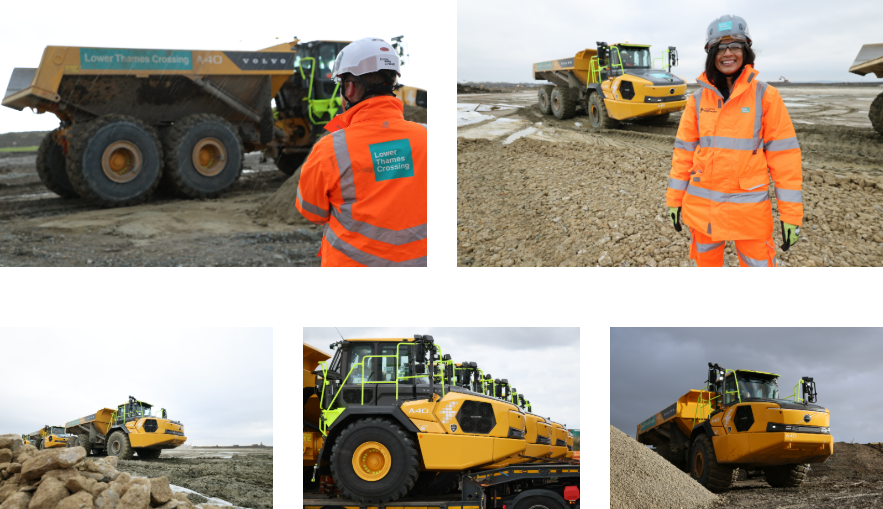
Four Volvo A40 Electric haulers, the world's largest production electric articulated dump trucks, have entered service on the £10 billion Lower Thames Crossing, marking a significant step in the project's ambition to deliver major construction works without conventional diesel-powered machinery.
The battery-electric haulers are being used by BMJV, a joint venture of Bouygues Travaux Publics and Murphy, near East Tilbury in Essex to move gravel, sand, stone and other materials during construction of foundations and structures associated with the new road and tunnel entrance.
Each machine can carry up to 39 tonnes and is equipped with a 540 kWh battery. Charging is being coordinated around work breaks and evening periods to minimise disruption to site operations, while regenerative braking returns energy to the battery during operation.
The machines are intended to perform the same heavy-duty earthmoving tasks as conventional articulated dump trucks but without tailpipe emissions. Lower noise and vibration are additional advantages for operators and nearby communities.
Electric construction plant normally faces challenges related to charging infrastructure, duty cycles and the high energy demand of heavy earthmoving equipment. On the Lower Thames Crossing, electricity for charging is being generated on site using British-produced green hydrogen, creating a temporary energy system designed around the requirements of electrically powered plant.
The project's wider construction strategy is also intended to reduce dependence on fossil fuels. Conventional diesel has not been used on its worksites since 2025, with machinery instead operating on hydrotreated vegetable oil, electricity or hydrogen.
Although battery-electric machines carry a higher initial purchase cost, the project expects lower electricity and maintenance costs to reduce their total lifetime operating cost compared with diesel and HVO alternatives. Their performance on a large infrastructure project will therefore provide useful evidence on whether heavy electric construction equipment can operate competitively under demanding site conditions.
The Lower Thames Crossing will create a new highway connection between Kent and Essex beneath the River Thames and is expected to almost double road capacity east of London. Early preparation works began in 2026, while major construction and tunnelling are scheduled to start in 2028.
More than 3,000 people are already working on the programme, with opening currently expected in the early to mid-2030s.
The project is also targeting carbon-neutral construction, although this relates specifically to the delivery phase rather than the environmental impact of road traffic once the crossing becomes operational. Campaigners, including the Kent branch of the Campaign to Protect Rural England, continue to question the broader effects of additional road capacity and argue for greater investment in rail and other lower-carbon transport alternatives.
For the construction sector, however, the deployment of 39-tonne battery-powered haulers represents an important practical test. If electric machinery can maintain productivity, charging availability and acceptable lifecycle costs on a project of this scale, similar systems could become increasingly viable across major earthworks, tunnelling and infrastructure programmes.
Sources: nationalhighways.co.uk, bbc.com
Want to read more like this story?

New crustal stress map of North America
Apr, 23, 2020 | NewsA new study presents the first quantitative stress magnitude map that also includes horizontal stre...

Using Terzaghi’s Equation in Foundation Design
Nov, 25, 2022 | NewsTheoretical models to predict the capacity of helical piles are based on Soil Mechanics and an appr...

Parameters Variation: Model Customization and Sensitivity Analyses
Sep, 15, 2021 | NewsA well-known engineering challenge in the framework of finite element (FE) analysis-based design is...

Repair of massive 50-meter sinkhole in Bangkok enters new challenge after structural breach
Sep, 26, 2025 | NewsIn the early hours of September 26, emergency efforts to stabilize the massive sinkhole in front of...
UK geothermal projects expand from Cornwall power to Birmingham heating
Apr, 16, 2026 | NewsThe United Kingdom is advancing geothermal energy development through a combination of deep geotherm...
Seven Frequently Asked Questions about Helical Piles
Apr, 29, 2026 | NewsHelical piles are a proven deep foundation solution used across commercial, industrial, utility, and...

Block caving: A new mining method arises
Jul, 25, 2018 | NewsBlock caving is a new alternative method of developing new mines or extending the operation of open...

Categories of isolated foundation footings
Jun, 25, 2019 | NewsThe foundation of a building is constructed in order to transfer the superstructure's load to the g...
Maharashtra's longest road tunnel to be completed soon
Oct, 17, 2022 | NewsMaharashtra's longest road tunnel between Igatpuri and Kasara is nearing completion. It is built as...
On This Day
November 28th 2019
READ MORE
Related Video

Trending

How Do Dams Trigger Earthquakes?

Quick Clay Failure on Norway’s E6 at Levanger

Keller North America announces recent leadership changes



Asbestos remains a deadly infrastructure risk across the UK

Major earthquake in southern Philippines causes deaths and widespread damage