Georgia Tech Digitizes George F. Sowers' 1940s Harvard Notes from Terzaghi and Casagrande
The Georgia Tech Geosystems group has released digital scans of course notes taken by Prof. George F. Sowers during his graduate studies at Harvard University in the late 1940s, offering the geotechnical community a rare, firsthand look at the field's founding era.
Sowers took the notes as a student in three courses taught by Karl Terzaghi and Arthur Casagrande: Soil Mechanics, Applied Soil Mechanics, and Engineering Geology. Terzaghi, widely regarded as the father of modern soil mechanics, and Casagrande, his longtime collaborator and the developer of the Casagrande liquid limit device still used in laboratories today, were shaping the discipline's fundamentals at Harvard at the time. Sowers completed his M.S. there in 1947 after wartime service in the U.S. Navy, then joined Georgia Tech, where he built the school's geotechnical engineering program from the ground up and went on to become a Regents Professor. His textbook, Introductory Soil Mechanics and Foundations, later became standard reading for generations of civil engineers, and he delivered the Terzaghi Lecture, one of the profession's highest honors.
The notes themselves, handwritten and richly detailed, are described by colleagues as "works of art" that document the reasoning of two of the discipline's founders as they worked through problems that still underpin practice today. They offer a window into how soil mechanics was taught and understood before it hardened into the standardized curriculum familiar to today's engineers.
Georgia Tech's announcement placed the notes in their historical moment, courtesy of Michael Bennett: in the fall of 1946, as Sowers began this coursework, Ted Williams and the Red Sox were losing a heartbreaking Game 7 of the World Series to the Cardinals, and Cambridge had just elected fellow Navy veteran John F. Kennedy to Congress. The following spring, Jackie Robinson broke baseball's color line playing against the Braves in Brooklyn — the same Braves franchise that would later relocate to Atlanta, in a sense following Sowers to Georgia Tech.
The scanning effort was led by Shaivan Shivaprakash and Yongjoon Choe of the Georgia Tech Geosystems group, with review from officers of the ASCE Georgia Geo-Institute chapter.
The three sets of notes are available for free download from the Georgia Tech Burns Lab's GeoResources page:
- Sowers, Engineering Geology of Soils (Terzaghi)
- Sowers, Applied Soil Mechanics (Terzaghi)
- Sowers, Soil Mechanics (Casagrande)
Access the full collection here
Want to read more like this story?

New crustal stress map of North America
Apr, 23, 2020 | NewsA new study presents the first quantitative stress magnitude map that also includes horizontal stre...

Using Terzaghi’s Equation in Foundation Design
Nov, 25, 2022 | NewsTheoretical models to predict the capacity of helical piles are based on Soil Mechanics and an appr...

Parameters Variation: Model Customization and Sensitivity Analyses
Sep, 15, 2021 | NewsA well-known engineering challenge in the framework of finite element (FE) analysis-based design is...

Repair of massive 50-meter sinkhole in Bangkok enters new challenge after structural breach
Sep, 26, 2025 | NewsIn the early hours of September 26, emergency efforts to stabilize the massive sinkhole in front of...
UK geothermal projects expand from Cornwall power to Birmingham heating
Apr, 16, 2026 | NewsThe United Kingdom is advancing geothermal energy development through a combination of deep geotherm...
Seven Frequently Asked Questions about Helical Piles
Apr, 29, 2026 | NewsHelical piles are a proven deep foundation solution used across commercial, industrial, utility, and...

Block caving: A new mining method arises
Jul, 25, 2018 | NewsBlock caving is a new alternative method of developing new mines or extending the operation of open...

Categories of isolated foundation footings
Jun, 25, 2019 | NewsThe foundation of a building is constructed in order to transfer the superstructure's load to the g...
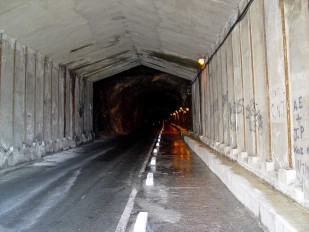
Maharashtra's longest road tunnel to be completed soon
Oct, 17, 2022 | NewsMaharashtra's longest road tunnel between Igatpuri and Kasara is nearing completion. It is built as...
On This Day
July 9th 0869
READ MORE
Related Video

Trending


Lake Chippewa’s floating island that has to be boat-pushed every year
How to Model Piles in PLAXIS

3 Types of Retaining Walls and Revetments

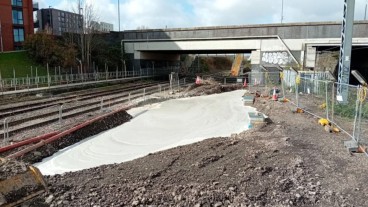
Emergency ground stabilisation protects rail works near Salford Central