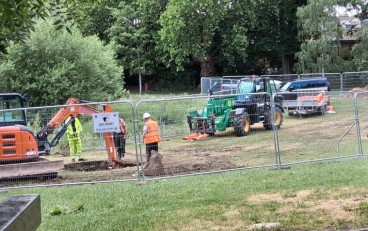
Inside the ground beneath Bologna’s Two Towers: 3D model pinpoints 570 kPa stress peak under leaning Garisenda Sponsored

University of Bologna researchers have combined a century of site investigations with a 3D finite element model to map the current stress state beneath the Garisenda and Asinelli towers – the geotechnical baseline for the stabilisation design now under way for the leaning Garisenda.
Key facts
|
|---|
Few monuments illustrate soil–structure interaction as vividly as the Two Towers of Bologna. The 97.2 m Asinelli and the shorter, markedly leaning Garisenda stand a few metres apart in the medieval centre of the city, founded on compressible, highly variable alluvial soils. In a paper for the 4th International Symposium on Geotechnical Engineering for the Preservation of Monuments and Historic Sites (ISSMGE TC301) in Athens, Alessio Mentani, Ilaria Bertolini, Michela Marchi and Guido Gottardi of the Department of Civil, Chemical, Environmental and Materials Engineering (DICAM) at the University of Bologna present an updated geotechnical model of the subsoil and a three-dimensional finite element analysis of both foundations. The aim is to quantify the stresses the towers currently impose on the ground and to provide a basis for the stabilisation measures being designed for the Garisenda, which has been closed to the public since autumn 2023.

Two towers, two construction histories
The Garisenda has a square base 7.4 m wide at ground level. Originally about 60 m high, it was shortened by about 12 m between 1350 and 1353 because the municipal government feared its growing inclination. Today it leans 3.32 m towards the south-east, corresponding to 3.914° eastward and 0.665° southward. It rests on a conglomerate foundation block about 8.75 m wide and 3.30 m high, with its founding plane about 5.5 m below ground. Above this sits a 4.8 m high selenite (gypsum stone) base built “a sacco”, with two facings and a rubble-and-mortar core, enclosed in a further selenite cladding in the early 20th century.
The Asinelli was most likely built later, on a larger foundation – about 10.45 m wide and 4.70 m high, founded at 6.7 m – probably because the Garisenda’s tilt had become apparent soon after its construction. Raised to its present height around 1250 and built more gradually, the Asinelli comprises three construction blocks with different inclinations, as medieval builders tried to correct the tilt during successive heightenings. The result is its slightly curved “banana” profile, with an average inclination of about 1.5° westward.
A century of investigation
Geometric surveys of the Garisenda date back to 1902. The first geotechnical campaign, in 1973–1975, comprised twelve continuous-core boreholes with undisturbed sampling and piezometers to 40 m. Five further boreholes and four CPTu followed in 1995, and in July 2000 vertical and inclined boreholes gave the first direct information on the previously unknown Garisenda foundation.
The most extensive campaign ran from May to August 2016: six CPTu, one downhole test, three dilatometer tests, vertical cored boreholes to 20, 40 and 100 m, two inclined boreholes intercepting the Asinelli foundation, and three boreholes through the Garisenda foundation to 15.5 m. Four piezometers measuring pore pressure down to 100 m and three deep settlement gauges beneath the Garisenda were installed. Eight shallow boreholes and two further piezometers were added in 2021.

Structural work has run in parallel. Masonry consolidation, a steel frame and tie rods were installed from 1998, and steel belts were added in 2008. When the selenite cladding on the east side – the direction of maximum lean – was seen to swell, mineralogical analyses showed that the selenite blocks had been altered by major fires in the late 14th and 17th centuries. Between 2019 and 2021 the base was reinforced with a passive FRCM belting system in the horizontal joints, post-tensioned stainless steel bars at the corners and a temporary funicular cable confinement.

Lithologically uniform, mechanically heterogeneous
The cores show an almost continuous sequence of interbedded silty clays and clayey silts; the 100 m borehole met only two very thin gravel layers, at 94.5 m and 97 m. Yet the CPTu, DMT and laboratory data reveal marked vertical and lateral variability in mechanical behaviour. The authors attribute this to interbedded paleosols – buried ancient soil horizons that are stiffer, stronger and apparently overconsolidated relative to non-pedogenised alluvium. Their properties vary between paleosols and even laterally within the same horizon, over distances comparable to a tower footprint, which may have contributed to the Garisenda’s initial tilting.
Using the Robertson (2009) Soil Behaviour Type approach, the deposit is divided into four units:
- Unit R (0–4.5 m): anthropogenic fill of variable grain size containing archaeological remains
- Unit A (4.5–16 m): silty clays and clayey silts with high scatter in strength and stress-history parameters due to dense paleosol interbedding
- Unit B (16–25.3 m): similar soils with less variability, reflecting more limited post-depositional alteration
- Unit C (25.3–28 m, the maximum depth characterised): normally consolidated soils with lower mechanical parameters
Piezometers place the water table at about 5.6 m below ground, with hydrostatic conditions to about 30 m and limited downward seepage between 30 m and 100 m.
A 3D model of both foundations
The soil–foundation system was modelled in Plaxis 3D, explicitly including the interaction between the two towers. The domain measures 35 m deep by 79 m by 98 m, with lateral boundaries about 35 m from each tower centre, roughly three foundation widths. Stratigraphy was interpolated from the 2016 investigation points. A linear-elastic soil model was adopted, with Young’s moduli derived from oedometer moduli over the relevant stress range: E = 3.7, 14.9, 19.3 and 11.9 MPa for units R, A, B and C respectively (ν = 0.3).
Both towers were idealised as rigid blocks with their actual foundation footprints. Foundation and selenite base masses (1,149 t for Garisenda, 1,596 t for Asinelli) act at the block centroids, while superstructure masses (3,471 t and 6,252 t) are applied at the projection of each tower’s center of gravity according to its actual inclination. A frictionless interface allows detachment at the foundation base. The mesh uses 10-noded tetrahedra with an average size of 1.2 m, refined to 0.05 m beneath the foundations.
Because elastic settlements alone could not reproduce the observed inclinations, the authors used a six-step iterative procedure: foundation planes were pre-inclined by imposing corner displacements equal to observed settlements minus computed elastic settlements, and founding depths were then corrected, so that the final stress state corresponds to the towers’ present load, tilt and depth.

Stress concentrations at the leaning edge
The final simulation shows no significant tensile zones, apart from a very thin layer at the two less loaded corners of the Asinelli footing. The highest compressive stresses occur beneath the Garisenda, reaching about 570 kPa effective vertical stress near its south-east corner – the deepest edge of the footing – and decreasing to about 140 kPa at 1 m and 80 kPa at 2 m below it. Beneath the Asinelli, the peak is about 470 kPa near the north-west corner, falling to about 100 kPa and 70 kPa at 1 m and 2 m. The two stress bulbs interact and develop fully within the upper 30 m; below that, stress changes and settlements become negligible.
At these stress levels, the authors note, local yielding is likely, with limited stress redistribution that an elastic model cannot capture. Computed elastic settlements of 0.23 m (Asinelli) and 0.22 m (Garisenda) are therefore lower bounds. Settlements inferred from the bending of buried paleosol horizons beneath the foundations are much larger: about 1.4 m for Asinelli and 1.2 m for Garisenda since construction.
Why it matters for practice
The study shows how leaning-tower problems depend on detailed site characterisation as much as on constitutive sophistication. Here, paleosol stratigraphy explains mechanical heterogeneity in an otherwise uniform clay–silt deposit, and a model that reproduces the towers’ present geometry gives a defensible picture of current contact stresses and stress bulb interaction. The authors are explicit about its limits: the elastic model does not back-analyse past movements or predict future ones. Next steps include elasto-plastic constitutive models calibrated on monitoring data to predict settlements and assess the long-term stability of both towers, feeding directly into the Garisenda stabilisation design.
Reference
Want to read more like this story?

The leaning tower of Bologna closes amid settlement concerns
Oct, 21, 2023 | NewsBologna’s leaning 48-meter tall Garisenda Tower was closed during the weekend, after worrying movem...

Worsening condition of Bologna’s “leaning tower” to require €20 million restoration work
Dec, 12, 2023 | NewsThings for Bologna’s leaning Garisenda Tower appear to have taken a turn for the worse, according t...

3D Modeling of Soil-Foundation-Structure Interaction: Case History at Fly Ash Silo, Maasvlakte Rotterdam
Sep, 14, 2020 | EducationNote: This Case History was first presented in Plaxis Bulletin, Autumn issue 2013, by L.F.J. Bekke...
How does the Leaning Tower of Pisa survive earthquakes
May, 22, 2018 | NewsDespite the hazardous inclination of approximately five degrees, the Leaning Tower of Pisa (in Italy...

Rocscience | Undrained analysis of a deep excavation in clayey soils using PLAXIS Hardening Soil model in RS2
Apr, 28, 2023 | NewsWhen analyzing a geotechnical problem, different design parameters are utilized depending on draine...

Tower of Pisa losing its tilt
Nov, 01, 2013 | NewsAccording to an annual report on the monument’s stability, the leaning Tower of Pisa has straightene...
Tutorial of finding the required depth of embedment of a sheet pile retaining wall using the global factor of safety and the Eurocode 7 approach
Feb, 06, 2026 | EducationA cantilever sheet pile wall supporting a 3.5 m deep excavation in dry sand (γdry = 15.3 kN/m³, φ′...
Numerical Analysis of a Cooling Tower Foundation Using FEM
Oct, 14, 2025 | EducationThis case study presents the application of the Finite Element Method (FEM) to design a ring founda...
Constitutive Modeling / Soil Behavior
Jun, 30, 2025 | EducationConstitutive Models in Geotechnical Engineering In geotechnical engineering, understanding the b...
Form
Looking for more information? Fill in the form and we will contact Seequent, The Bentley Subsurface Company for you.
On This Day
October 7th 1922
READ MORE
Related Video

Trending

Life after gINT - Rethinking geotechnical data management for a new era

Is Africa gradually splitting into two sections?
Stop Guessing, Start Designing: Introducing Support Designer in Slide2
Alert level is raised in Mexico as the Popocatépetl volcano spews ash and gas
Deadly mining landslide in Central African Republic raises safety concerns