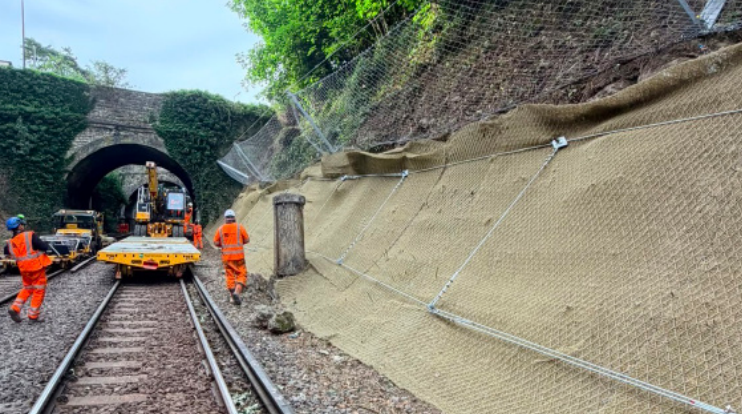
Rockfall protection works at Maidstone East, where catch fencing was installed along a steep railway cutting with a history of instability. Source: Universal piling (from report Maidstone East)
Railway cuttings can be among the most sensitive geotechnical assets on transport networks. They are often steep, weathered, difficult to access and located directly beside live operational infrastructure. At Maidstone East, a major rockfall protection and slope stabilisation scheme was delivered during a tightly constrained 9-day railway possession, demonstrating how rapid geotechnical intervention can help reduce risk on vulnerable rail corridors.
The works focused on a steep rock cutting with a long-established history of instability and rockfall events. The main protection system included 428 m of Geobrugg 100A-R catch fencing, supported by soil nailing, rope access operations, specialist drilling and additional rockfall mitigation measures.
Before the main works could proceed, vegetation was cleared from the lower sections of the cutting face to expose the slope and allow inspection, setting out and drilling. This stage proved critical. Once the face was visible, a section beneath the proposed fence alignment showed signs of instability and required immediate additional stabilisation.
Rockfall protection is not only about catching falling material. It also requires an understanding of slope behaviour and the selection of an appropriate combination of active and passive measures. In this case, the catch fence was installed to intercept falling debris before it could reach the railway, while soil nails and passive netting were used to stabilise and restrain vulnerable areas of the cutting face.
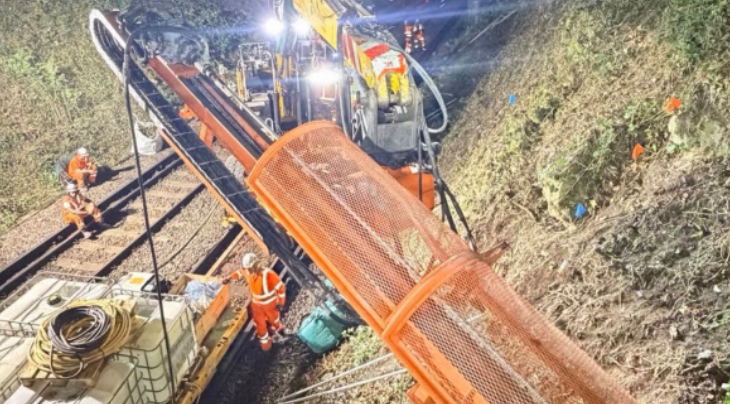
Soil nailing and specialist drilling were used to provide anchorage and improve the stability of vulnerable sections of the cutting face. Source: Universal Piling, from the Maidstone East case study.
The original works included the installation of 98 R32 soil nails to depths of 3.5 m and 5 m, using high-strength rapid-setting grout. This was important because the possession period was short and follow-on works could not wait for long curing periods. According to the case study, the grout achieved full design strength within 24 hours, allowing fence installation to continue without delay.
The catch fence system required 35 posts, four brace posts and eight support rope separation anchors across both sides of the cutting. Approximately 1,300 m of cable, 130 cable grips and 180 helix coils were used to complete the 428 m installation. The system comprised 168 m on the Down side and 260 m on the Up side of the cutting.
During the blockade, additional instability was identified beneath the proposed fence alignment. The revised solution added 30 soil nails and 176 m² of passive rockfall netting beyond the original scope. This rapid design adjustment was essential because handing back the railway without treating the unstable zone would have left a residual risk to the asset and future operations.
The technical challenge was increased by the site constraints. Works had to be completed during a limited railway possession, with multiple contractors operating at the same time. Access was restricted, the cutting was steep, and fibre optic and high-voltage services were present within the cess.
Rail-road vehicles with mounted access platforms and drilling equipment were used to reach the cutting face. Rope access technicians supported drilling, lifting, cabling and mesh installation. Exclusion zones were established during drilling, while protective measures, including Terram membrane and crash barriers, were used to protect buried services and prevent ballast contamination.
The project highlights an important principle in geotechnical asset management: slope conditions can become clearer once vegetation is removed and the ground is properly exposed. Design and construction teams must therefore remain adaptable, especially where legacy cuttings have a known history of instability.
For rail infrastructure, the outcome is not only a completed fence or a stabilised slope. It is a reduction in operational risk. Effective rockfall protection helps prevent debris from reaching the track, improves corridor resilience and supports safer railway operation in areas where unstable ground remains an ongoing threat.
Geoengineer.org uses third party cookies to improve our website and your experience when using it. To find out more about the cookies we use and how to delete them visit our Cookies page. Allow cookies