New study investigates partial replacement of Portland cement with waste London Clay
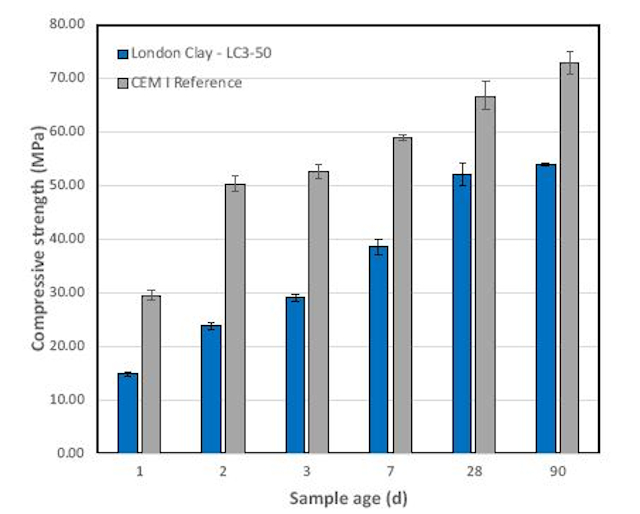
A new paper titled “Reutilising waste clays from tunnelling operations as a cement replacement material in concrete - An innovative circular approach” by Kanavaris, F., et al., discusses the effectiveness of partially substituting Portland cement in concrete mixes with London Clay, obtained as excavation waste.
Furthermore, the process of cement production uses large amounts of energy, namely accounting for 8% of worldwide CO2 emissions, while concrete demand is steadily increasing and has reached a consumption of 30 billion tons a year, which is triple what it was forty years ago.
Hence, byproducts of coal consumption or steelmaking, such as fly ash and ground granulated blast furnace slag have been used to substitute cement in concrete. However, their production rate has been decreasing due to the phasing out of these industries.
Clays, after being treated, have been proven to be a suitable substitute for cement, while in large scale projects, only a small portion of them would be reused and the rest would be transported to landfills.
Moreover, clays can generally be divided into three categories in terms of their ability to substitute cement, and this division depends on their kaolinite content, with the rule being that more is better.
Heating some clays at an average of 800 degrees Celsius for about an hour would enable them to be used in concrete, through a process called calcination.
This paper mainly discusses London Clay, which regularly has a kaolinite content of 10%-20%, that would be considered rather low-grade.
The results showed that substituting 50% of cement with a mix of London Clay, limestone, and gypsum (at 35%, 15% and 5% respectively) yielded a 28-day sample compressive strength of 50 MPa.
This was rather important, as UK standards allow up to 55% of cement to be replaced by calcined pozzolana.
Finally, the study suggests that its findings can be extrapolated to similar materials in other parts of the planet, while clay wastes can also be utilized in lightweight concrete applications in the form of expanded clay aggregate.
It would also be worth noting that several studies are investigating suitable materials that could serve this purpose, such as this one that used spent coffee grounds.
Sources: www.researchgate.net, www.iom3.org
Want to read more like this story?

HS2 Team Trials Low-Carbon Clay Alternative to Concrete
Oct, 07, 2024 | NewsThe HS2 project team, working on the London tunnels, has embarked on an innovative journey to reduc...

The phenomenon of Quick Clays
Jul, 03, 2020 | EducationIntroduction Quick clay refers to a specific type of clayey material that experiences a significa...

Deep cement mixing linked to deadly quick clay failure in Norway
Mar, 18, 2026 | NewsA fatal landslide that occurred during a railway expansion project in Levanger, Norway, has been li...
Concrete / Rollercrete Dams
May, 22, 2019 | EducationGravity Dams A Gravity Dam is made of soil, rock, concrete or masonry. For soil and rock dams, s...

Bentley Webinar: Field-Measured Heave in London Clay: Insights from 3D FEA and Advanced Constitutive Modeling
May, 19, 2025 | EventJoin this Bentley webinar for key takeaways for engineering design in London clay and future applic...

Transforming Foundations: CEM VI Concrete Offers Low-Carbon Solutions
Dec, 19, 2024 | NewsThe construction industry is stepping up its game to tackle embodied carbon, and a recent project a...

Quick clay landslide hits Norway sweeping away houses
Dec, 30, 2020 | NewsA massive quick clay landslide struck in a Norwegian village sweeping away buildings. The landslide...

Large waste landslide struck in Colombia's landfill
Apr, 28, 2020 | NewsA large waste landslide struck in a landfill located outside of Bogota, the capital city of Colombi...

Massive landslide sweeps away houses in Norway
Jun, 03, 2020 | NewsEight residences have been swept away by a vast landslide that struck in Norway. The incident occur...
On This Day
August 6th 1966
READ MORE
Related Video

Trending

Unstable Ground: Lessons from the I-80 New Jersey Sinkhole Saga

Seequent announced extended gINT support until Dec 31, 2028

New Release: GeoStudio 2025.2

Artificial Ground Freezing: Applications, Techniques, and Key Considerations
Nepal’s Himalayan settlements face escalating flood and landslide threats