The latest PLAXIS release has been updated to include design approaches for PLAXIS 3D. Users can now design in accordance with Eurocode or other methods that utilize partial factors within the 3D design frameworks. Additionally, an improved conversion facility has been implemented for older PLAXIS 2D and 3D projects when opened with the latest version. Furthermore, the modal analysis feature for Monopile Designer has now transitioned into general availability.
Design Approaches in PLAXIS 3D

With Design Approaches users can store, manage and apply sets of partial factors in a general way in their analysis. Previously available only PLAXIS 2D, this allows users to apply modelling principles considering partial factors for soils and loads, to follow Eurocode or LRFD, and more easily set up SLS and ULS analysis in PLAXIS 3D projects. Users can import and export Design approaches to easily share and reuse those from existing 2D projects in their 3D projects. Design approaches are also included when using the 2D to 3D Converter, ensuring they end up seamlessly in the generated 3D geometry. Design approaches are only available in Advanced and Ultimate tiers.
Improved version handling and file updater

A new conversion facility is included for PLAXIS projects that were created in earlier versions. This provides users with a more robust experience than before when opening old projects in new versions of PLAXIS, reducing the risk of data loss and properly converting modified properties. Additionally, this new tool can also help users determine in which PLAXIS version the project was originally created or calculated. The conversion facility will automatically save the project with a converted suffix to ensure the original project is not overwritten, when conversion is required. It's highly recommended to open old projects from local storage devices. Using cloud-based or network-based storage locations directly may negatively impact the performance of the conversion process, especially for unsynchronized cloud storage. Conversion of projects is supported for projects from PLAXIS 2D and 3D 2017 and later.
Small enhancements, fixes and changes
- Discontinuity elements now block groundwater flow when the material set’s drainage type is set to non-porous.
- The remote scripting server is now only started on the localhost for enhanced protection. Python scripts can still be executed on the local machines this way.
- CreepRock models renamed from CreepRock_N2PC and CreepRock_N2PC_MCT, to CreepRock-N2PC and CreepRock-N2PC-MCT. This change will require CreepRock model selection and parameter input to be redone when opening projects containing an assigned CreepRock model.
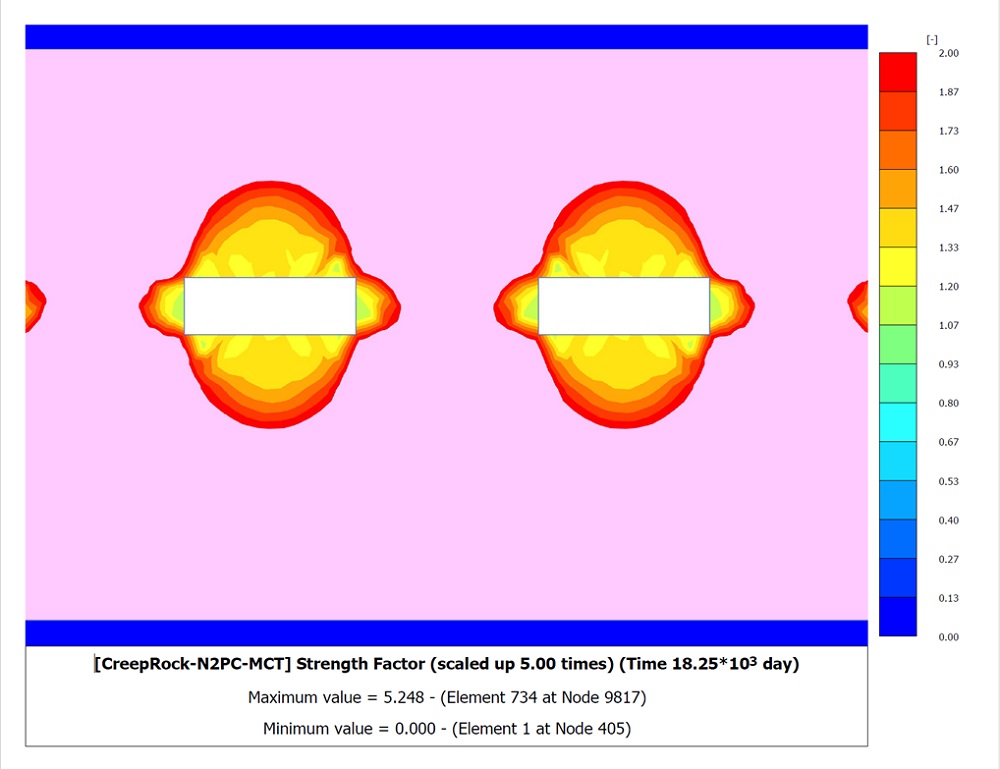
- Strength Factor is now available for the CreepRock-N2PC-MCT model as a state parameter in Output (Advanced and Ultimate tier only). This parameter acts as a safety factor, calculated by comparing the strength of the rock salt to the stress it experiences. It is essential for evaluating and predicting the stability of the salt rock structures and conditions. The figure below illustrates the variations in strength factor around the underground excavated rooms in salt rock mining.
- In Output, Use result smoothing now consistently follows the chosen setting by the user when switching to or between various result types or tables. By default, Use result smoothing is active, which is now also consistently applied.
PLAXIS Monopile Designer
Modal analysis (General Availability)
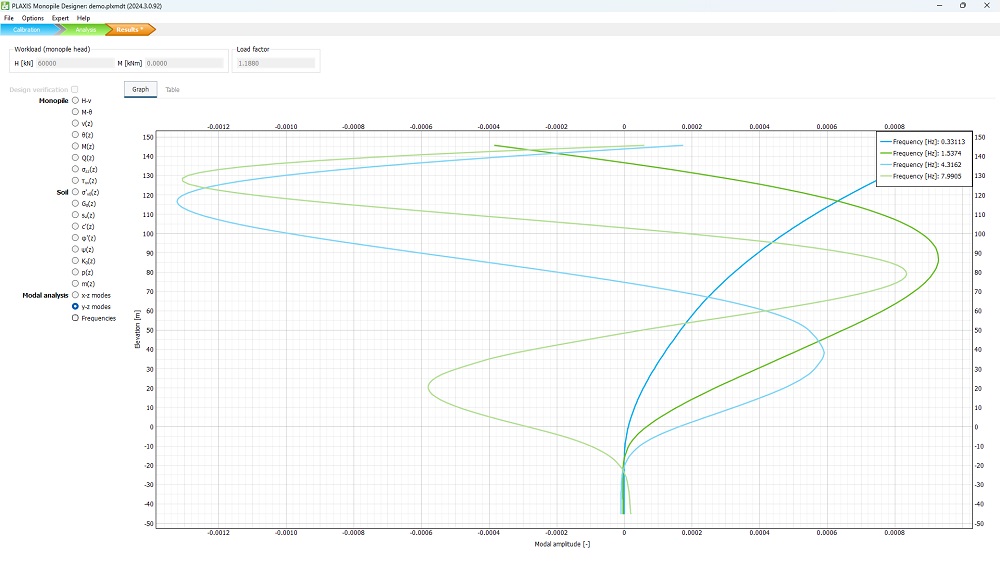
Offshore wind turbines are subject to a very large number of cyclic loads, more than any other structure ever built. Engineers need to calculate the natural vibration frequencies and vibration modes for the monopile-tower-nacelle system, considering the influence of soil-structure interaction, to ensure they provide a resilient design.
Modal analysis, previously released as a Technology Preview, enables you to determine the natural vibration frequencies and vibration modes for the monopile-tower-nacelle system. The rotor-nacelle assembly is modelled as a lumped mass. Soil-structure interaction can be considered through the initial stiffness of the soil reaction curves or ignored by specifying a ‘clamped’ condition.
Small enhancements and fixes
- To assist Calibration it is now possible to visualise the specified geometry data sets in a normalised L/D-h/D design space.
- Cohesion (c’) and the exponent of the stiffness depth-dependency relation (m) can now be specified for sand profiles. The previous default values c’ = 0.1 kPa and m = 0.5 will be automatically applied to existing projects.
- Added support for tapered monopile sections in 3D design verification models.
- Calibration model charts are now grouped by Soil Profile, enabling visibility toggling for the whole group.
So, update to our latest editions to benefit from these new features and software improvements using either the CONNECTION Client or by downloading the software yourself today!
Want to read more like this story?

New release PLAXIS CONNECT Edition V22 Update 1 is out!
May, 19, 2022 | NewsIn this latest minor release for PLAXIS 2D, PLAXIS 3D and Monopile Designer Bentley Systems introdu...

New major release PLAXIS CONNECT Edition V22.00 is out!
Jan, 28, 2022 | NewsPLAXIS V22 brings a major overhaul to the data structure of the material database and a more flexib...

PLAXIS 2023.2 New release is out!
Sep, 07, 2023 | NewsThis latest release solidifies Seequent's Connected Geotechnical Workflow, reducing the need for du...

New releases: PLAXIS CONNECT Edition V22 Update 2 is out!
Oct, 13, 2022 | NewsWith the latest release of PLAXIS 2D, PLAXIS 3D, and PLAXIS Monopile Designer, Bentley continues to...

PLAXIS 2024.2 New release is out!
Sep, 04, 2024 | NewsThis latest PLAXIS release includes two new user defined materials models, one that helps improving...

New release of PLAXIS CONNECT Edition V20 Update 1
Jan, 20, 2020 | NewsPLAXIS CONNECT Edition version 20.0 includes streamlined user experience, increased performance an...

Bentley releases new PLAXIS versions
Jun, 15, 2020 | NewsBentley is happy to announce the release of new PLAXIS CONNECT version (Edition V20 Update 3), incl...

PLAXIS CONNECT Edition V20 Update 4
Jan, 11, 2021 | NewsBentley Geotechnical Engineering experts are continuously improving PLAXIS CONNECT Edition. In this...
PLAXIS 2024.1 New release is out!
Feb, 24, 2024 | NewsWith PLAXIS 2024.1 users benefit from enhancements for designing and reinforcing underground excava...
Form
Looking for more information? Fill in the form and we will contact Seequent, The Bentley Subsurface Company for you.
On This Day
August 6th 1844
READ MORE
Related Video

Trending

Chesapeake Bay Bridge-Tunnel: An ‘engineering wonder’ of the modern world

What controls the height of the world's mountains?

AI-enhanced landslide model ready for 2026 deployment in Hong Kong
Nepal’s Himalayan settlements face escalating flood and landslide threats