All tunnelling completed for Toronto's Eglinton Crosstown West Extension

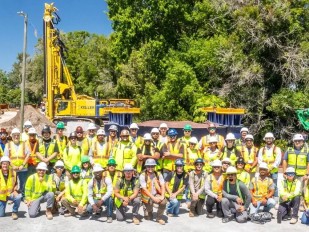
Tunnelling has been completed for the Eglinton Crosstown West Extension in Toronto following breakthrough of the final 500 m twin tunnels between Jane Street and Mount Dennis Station.
The latest section connects the western extension directly into Line 5 Eglinton at Mount Dennis and marks the completion of all tunnel excavation for the 9.2 km project. Construction of the final tunnels began in February and was carried out using the sequential excavation method rather than a tunnel boring machine.

With underground excavation now complete, work is continuing on four new underground stations and a 1.5 km elevated guideway as the project moves into its next construction phases.
The final twin tunnels between Jane Street and Mount Dennis were constructed using the sequential excavation method, which divides the tunnel face into smaller sections that are excavated progressively.
As each section is opened, sprayed concrete is applied to the exposed ground to provide immediate support and maintain stability. Progress is typically around 1 m to 2 m per day, considerably slower than a tunnel boring machine but well suited to shorter or geometrically constrained underground sections.
The method also gives engineers greater flexibility to adjust the excavation and support sequence to local ground behaviour. This is especially useful near existing stations, structures or complex interfaces where the tunnel geometry may not justify mobilisation of a large TBM.
The breakthrough at Mount Dennis completes the underground connection into the existing Line 5 Eglinton infrastructure.
The latest tunnels form only a small part of the underground works delivered for the extension. In 2024, twin TBMs named Renny and Rexy completed approximately 6.3 km of parallel tunnels between Renforth Drive and Scarlett Road. The machines spent around two years excavating the western underground section before reaching the point where the future line transitions toward the surface.
The combination of TBM excavation for the long uniform section and sequential excavation for the shorter connection near Mount Dennis illustrates how different tunnelling methods can be used within the same rail project depending on geometry, ground conditions, access and construction constraints.
Although tunnelling is now finished, major civil works remain under way. Excavation has started for underground stations at Martin Grove, Kipling, Islington and Royal York, while construction of the elevated guideway is progressing. Once complete, the Eglinton Crosstown West Extension will add seven new stations to Line 5 Eglinton and extend rapid transit west toward Mississauga. The project is expected to bring improved transit access to around 37,500 additional residents and 23,600 jobs.
Completion of the tunnels removes one of the major underground construction risks from the programme. The focus now shifts toward stations, structures, systems installation and integration of the new infrastructure with the wider Line 5 network.
Sources: https://www.metrolinx.com/en/news/tunnelling-wraps-up-on-the-eglinton-crosstown-west-extension, tunnelingonline.com
Want to read more like this story?

New crustal stress map of North America
Apr, 23, 2020 | NewsA new study presents the first quantitative stress magnitude map that also includes horizontal stre...

Using Terzaghi’s Equation in Foundation Design
Nov, 25, 2022 | NewsTheoretical models to predict the capacity of helical piles are based on Soil Mechanics and an appr...

Parameters Variation: Model Customization and Sensitivity Analyses
Sep, 15, 2021 | NewsA well-known engineering challenge in the framework of finite element (FE) analysis-based design is...

Repair of massive 50-meter sinkhole in Bangkok enters new challenge after structural breach
Sep, 26, 2025 | NewsIn the early hours of September 26, emergency efforts to stabilize the massive sinkhole in front of...
UK geothermal projects expand from Cornwall power to Birmingham heating
Apr, 16, 2026 | NewsThe United Kingdom is advancing geothermal energy development through a combination of deep geotherm...
Seven Frequently Asked Questions about Helical Piles
Apr, 29, 2026 | NewsHelical piles are a proven deep foundation solution used across commercial, industrial, utility, and...

Block caving: A new mining method arises
Jul, 25, 2018 | NewsBlock caving is a new alternative method of developing new mines or extending the operation of open...

Categories of isolated foundation footings
Jun, 25, 2019 | NewsThe foundation of a building is constructed in order to transfer the superstructure's load to the g...
Maharashtra's longest road tunnel to be completed soon
Oct, 17, 2022 | NewsMaharashtra's longest road tunnel between Igatpuri and Kasara is nearing completion. It is built as...
On This Day
September 22nd 1965
READ MORE
Related Video

Trending
Sinkhole outside home in Huntington Station, on Long Island: 3 fall into
Dubai approves $9.2bn fully underground gold line metro
How to prevent copper wire theft from light poles

The quicksand of Morecambe Bay

Model Structures and Visualize Structural Forces
Stop Guessing, Start Designing: Introducing Support Designer in Slide2
Development program prepares new engineers for success