Four 120 m boreholes unlock flooded Bochum mine for geothermal heat storage tests

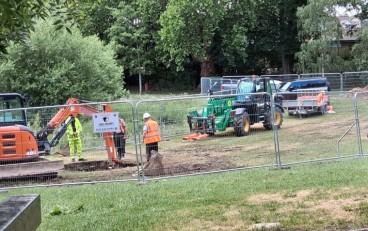
Researchers in Germany have successfully drilled four boreholes into a flooded former coal mine in Bochum, demonstrating that abandoned mine workings can be accessed using conventional geothermal drilling equipment rather than more complex directional drilling systems.
The work forms part of the EU-funded PUSH-IT project, which is investigating how underground formations can be used for high-temperature thermal energy storage. At the Bochum site, researchers are assessing whether flooded mine workings can act both as a heat source and as a subsurface storage system for excess thermal energy.
Fraunhofer IEG used its mobile BO.REX drilling rig to reach mine cavities approximately 120 m below ground. The target openings were only a few metres wide, making drilling accuracy critical. Detailed subsurface information, careful pre-planning and specially adapted ballast weights on the drill string were used to guide the boreholes into the intended mine workings.

The rig itself is relatively compact for the task. It is approximately 2.5 m wide, has a mast more than 12 m high and a pulling force of around 40 tonnes. Its dimensions allow it to operate in constrained urban environments, an important consideration because many abandoned mines are located beneath or close to developed areas.
The successful drilling suggests that flooded mines could potentially be accessed without relying on the larger and more complex directional drilling systems commonly associated with oil and gas operations. This could make mine-water geothermal systems more practical for municipal utilities, local authorities and commercial developments where the subsurface geometry is sufficiently well understood.
Flooded mines can contain large volumes of water capable of storing thermal energy. In principle, heat can be extracted for heating during winter, while surplus heat from buildings, industrial processes or data centres could be stored underground and reused later. The concept therefore combines geothermal heat utilisation with seasonal thermal storage.
Following drilling, researchers installed monitoring sensors in the boreholes and deployed an underwater drone to inspect the mine cavities. Images showed clear and turbid water layers together with the surrounding rock walls, confirming that the boreholes had intersected the intended underground workings.
The boreholes now provide the basis for the next phase of the project, which will test the thermal storage capacity of the mine water system. These tests will determine how much heat the flooded workings can store and recover, and whether the performance is sufficient to justify investment in pumps, heat exchangers, surface pipework and other infrastructure.
The results will also help determine whether the system could serve local users in southern Bochum, including buildings and data centres requiring heating or cooling.
The project demonstrates how former mining infrastructure can potentially be repurposed rather than treated solely as a post-mining liability. However, the upcoming storage tests will be decisive in establishing whether the concept is technically and economically viable at this specific site.
Sources: geodrillinginternational.com, mining-report.de, adalytica.com
Want to read more like this story?

New crustal stress map of North America
Apr, 23, 2020 | NewsA new study presents the first quantitative stress magnitude map that also includes horizontal stre...

Using Terzaghi’s Equation in Foundation Design
Nov, 25, 2022 | NewsTheoretical models to predict the capacity of helical piles are based on Soil Mechanics and an appr...

Parameters Variation: Model Customization and Sensitivity Analyses
Sep, 15, 2021 | NewsA well-known engineering challenge in the framework of finite element (FE) analysis-based design is...

Repair of massive 50-meter sinkhole in Bangkok enters new challenge after structural breach
Sep, 26, 2025 | NewsIn the early hours of September 26, emergency efforts to stabilize the massive sinkhole in front of...
UK geothermal projects expand from Cornwall power to Birmingham heating
Apr, 16, 2026 | NewsThe United Kingdom is advancing geothermal energy development through a combination of deep geotherm...
Seven Frequently Asked Questions about Helical Piles
Apr, 29, 2026 | NewsHelical piles are a proven deep foundation solution used across commercial, industrial, utility, and...

Block caving: A new mining method arises
Jul, 25, 2018 | NewsBlock caving is a new alternative method of developing new mines or extending the operation of open...

Categories of isolated foundation footings
Jun, 25, 2019 | NewsThe foundation of a building is constructed in order to transfer the superstructure's load to the g...
Maharashtra's longest road tunnel to be completed soon
Oct, 17, 2022 | NewsMaharashtra's longest road tunnel between Igatpuri and Kasara is nearing completion. It is built as...
On This Day
November 9th 2000
READ MORE
Related Video

Trending

Carnian Pluvial Episode: That time when it rained for 1-2 million years

China's Three Gorges Dam under pressure: Flood hazard downstream

Functional requirements of foundation structures


Landslide in Papua New Guinea: At least 12 people dead
Deadly mining landslide in Central African Republic raises safety concerns