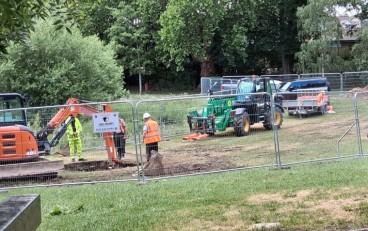
New UK toolkit targets consistent classification of excavated soils under WM3

A new technical toolkit has been launched to help contractors, groundworks specialists and waste producers classify excavated soils more consistently under WM3 requirements in England and Wales.
The package includes a Waste Classification Sampling Workbook and accompanying guidance covering the full process from initial site assessment through sampling, laboratory testing, stockpile management and final waste coding.
Correct classification of excavated soil is a recurring challenge on construction and infrastructure projects because material generated during earthworks may contain variable concentrations of contaminants and cannot always be treated as a single homogeneous waste stream. Classification decisions can affect whether soils are reused, treated, transported or disposed of, with significant consequences for project cost, programme, environmental impact and regulatory compliance.
The new framework begins with desktop studies and the definition of individual waste populations before sampling takes place. This is intended to ensure that materials with different origins, characteristics or contamination histories are not grouped together without justification.
Statistical sampling is another important part of the process. Rather than relying on isolated test results, the guidance promotes a structured approach to establishing representative sampling populations and determining whether sufficient data have been collected to support a defensible classification.
Laboratory testing is then used to characterise the material, with the guidance emphasising engagement with appropriately accredited laboratories. Results can subsequently be used to assess whether the soil contains hazardous properties and to assign the correct European Waste Catalogue code.
Stockpile management is also addressed because soils can easily become mixed during excavation, temporary storage and handling. Maintaining separation between defined material populations can therefore be as important as the analytical testing itself. Poor segregation can invalidate earlier sampling and make subsequent classification considerably more difficult.
The toolkit is intended to support wider circular economy objectives within the built environment. Better understanding of excavated material can help identify opportunities for reuse and recovery while reducing unnecessary disposal of soils that may otherwise have a beneficial use.
This is particularly relevant for large infrastructure projects where excavation can generate substantial volumes of material. Even relatively small improvements in classification and material segregation can reduce haulage, disposal demand and associated carbon emissions.
The guidance therefore connects waste regulation with geotechnical investigation, earthworks planning and construction logistics. Decisions made during early ground investigation and excavation planning can have a direct influence on how efficiently materials are managed later in the project.
By providing a more structured process for defining waste populations, sampling, testing and classification, the toolkit aims to reduce uncertainty around one of the more technically complex interfaces between construction and waste management.
Sources: ciwm.co.uk, agg-net.com, ciwm.co.uk
Want to read more like this story?

New crustal stress map of North America
Apr, 23, 2020 | NewsA new study presents the first quantitative stress magnitude map that also includes horizontal stre...

Using Terzaghi’s Equation in Foundation Design
Nov, 25, 2022 | NewsTheoretical models to predict the capacity of helical piles are based on Soil Mechanics and an appr...

Parameters Variation: Model Customization and Sensitivity Analyses
Sep, 15, 2021 | NewsA well-known engineering challenge in the framework of finite element (FE) analysis-based design is...

Repair of massive 50-meter sinkhole in Bangkok enters new challenge after structural breach
Sep, 26, 2025 | NewsIn the early hours of September 26, emergency efforts to stabilize the massive sinkhole in front of...
UK geothermal projects expand from Cornwall power to Birmingham heating
Apr, 16, 2026 | NewsThe United Kingdom is advancing geothermal energy development through a combination of deep geotherm...
Seven Frequently Asked Questions about Helical Piles
Apr, 29, 2026 | NewsHelical piles are a proven deep foundation solution used across commercial, industrial, utility, and...

Block caving: A new mining method arises
Jul, 25, 2018 | NewsBlock caving is a new alternative method of developing new mines or extending the operation of open...

Categories of isolated foundation footings
Jun, 25, 2019 | NewsThe foundation of a building is constructed in order to transfer the superstructure's load to the g...
Maharashtra's longest road tunnel to be completed soon
Oct, 17, 2022 | NewsMaharashtra's longest road tunnel between Igatpuri and Kasara is nearing completion. It is built as...
On This Day
November 14th 2001
READ MORE
Related Video

Trending

Carnian Pluvial Episode: That time when it rained for 1-2 million years

China's Three Gorges Dam under pressure: Flood hazard downstream

Functional requirements of foundation structures


Landslide in Papua New Guinea: At least 12 people dead
Deadly mining landslide in Central African Republic raises safety concerns