One dead after Penang landslide hits home as leaking pipe and drainage come under investigation

A 73-year-old man has died after a landslide struck a two-storey semi-detached house in Paya Terubong, Penang, while preliminary investigations focus on drainage conditions and incomplete slope stabilisation works on a nearby hillside construction site as possible contributors to the failure.
The landslide occurred at about 8.36am on Sunday 25 October in Taman Seri Rambai, where a mass of soil, rock and concrete moved downslope and struck the rear of the property. Three people were caught in the incident. Two escaped unhurt, while Dr Wong Kar Lin, who was on the ground floor at the time, remained trapped beneath the debris. His body was recovered at about 11.20am.
Attention quickly shifted to an adjacent hillside where road and condominium construction has been under way for more than a year. Slope stabilisation works were already being carried out as part of the development, but Penang infrastructure committee chairman Zairil Khir Johari said the section where work was still in progress was the one that gave way.
Penang Island City Council (MBPP) mayor Datuk A. Rajendran issued an immediate stop-work order for the condominium and roadworks while investigations continue, with the developer required to carry out mitigation works and submit a fresh environmental impact study. Authorities have stressed that the exact cause has not yet been established, but preliminary observations indicate that a leaking water pipe on the slope and clogged drainage may have allowed water to accumulate within the ground.
That possibility is significant given that heavy overnight rainfall had already battered Penang, triggering flash floods elsewhere on the island before the slope failed. Water entering a slope from a damaged pipe or obstructed drainage system can compound rainfall infiltration, raising moisture content and pore water pressure within the ground. As effective stress decreases, the available shear strength of the soil can reduce, potentially allowing an already vulnerable section of slope to move.

Ground movement was reportedly still being detected after the initial failure, preventing the incident from being treated simply as a completed landslide. Concerns were also raised over a heavy crane and large concrete blocks positioned within the affected construction area, which could become unstable if further ground movement occurs.
Immediate measures have therefore concentrated on reducing the consequences of any additional movement. The exposed slope is being covered with plastic sheeting to limit further water infiltration during rainfall, while residents of six nearby houses identified as potentially unsafe have been ordered to evacuate for an expected five days, with a community hall activated as a temporary relief centre. Technical assessments are being carried out by MBPP, the Department of Minerals and Geoscience and the Public Works Department.
The investigation will need to establish the source and duration of the suspected leakage, the condition and capacity of the drainage system, the progress of the incomplete stabilisation works and whether construction loads influenced the behaviour of the slope. Monitoring of continuing movement will also be important before decisions are made on permanent remedial measures. Chief Minister Chow Kon Yeow has said the landowner and developer must take responsibility for the affected area, and has given the developer seven days to submit a mitigation plan.
The Penang incident demonstrates how slope stability can depend as much on water management as on the geometry of the slope itself. A relatively localised leak or obstructed drain can alter subsurface conditions significantly, particularly on disturbed or partially stabilised ground already loaded by heavy rainfall. Environmental group Sahabat Alam Malaysia said the risk had been foreseeable given extensive hill-cutting in an area already known to be landslide-prone, and that residents had warned about it repeatedly. With one person killed and neighbouring properties evacuated, determining how water accumulated within the hillside will now be central to understanding why the failure occurred and how the slope can be made safe.
Sources: malaymail.com, channelnewsasia.com
Want to read more like this story?
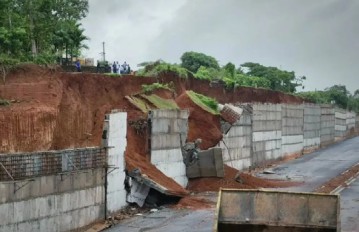
Heavy rain triggers retaining wall collapse at highway construction site in Karnataka
Jul, 02, 2026 | NewsA retaining wall and part of a hillside collapsed at an under-construction National Highway site nea...

Slope Stability
Jun, 02, 2019 | EducationA slope is an inclined ground surface which can be either natural or human-made. Slope stability...

Rainfall saturation triggers deadly hillside collapses in Ethiopia
Mar, 13, 2026 | NewsAt least 102 people have been killed after a series of landslides and floods struck the Gamo Zone i...

Skye road restored after 300-tonne landslide with rock armour and drainage works
Oct, 10, 2026 | NewsAround 300 tonnes of rock, soil and debris were removed from a key road on the Isle of Skye after a...
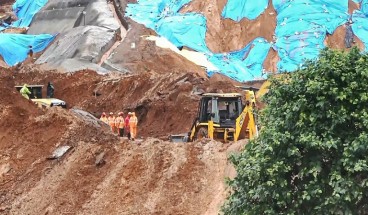
Fatal landslide exposes construction-stage risks around tunnel portals
Jul, 08, 2026 | NewsA fatal landslide at the under-construction Anakkampoyil-Kalladi-Meppadi road tunnel project in Kera...

Introduction to Slope Stability
Mar, 03, 2021 | EducationTopics on Slope Stability Analysis Geoengineer.org has gathered and presented educational mate...
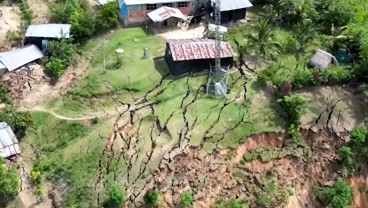
Landslide in Northern Peru Forces Evacuation of Over 170 Residents
Apr, 18, 2026 | NewsMore than 170 people have been evacuated from their homes in northern Peru following a landslide and...

Afaahiti hillside collapse leaves eight dead as saturated slopes fail in Tahiti
Nov, 27, 2025 | NewsA catastrophic landslide in the village of Afaahiti, on Tahiti’s southeastern coast, has left at le...
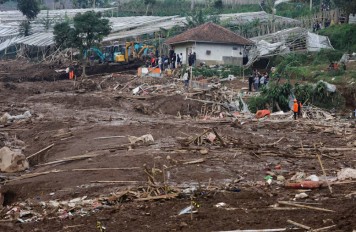
Dozens missing following deadly landslide in West Bandung
Jan, 24, 2026 | NewsAuthorities in Indonesia are continuing large-scale search and recovery operations after a major la...
On This Day
November 3rd 2010
READ MORE
Related Video

Trending

Seven Frequently Asked Questions about Helical Piles

Block caving: A new mining method arises

Categories of isolated foundation footings
Maharashtra's longest road tunnel to be completed soon

Carnian Pluvial Episode: That time when it rained for 1-2 million years
Emergency ground stabilisation protects rail works near Salford Central