Scientists directly observe submarine landslides in nature for the first time

Scientists have directly monitored fully submerged landslides as they happened in the natural environment for the first time, revealing how apparently small seabed failures can develop gradually and generate sediment flows that continue for hours.
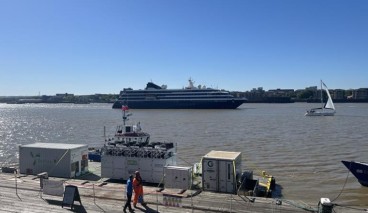
The observations were made during an 18-day field campaign at the Homathko Delta in British Columbia, where researchers combined high-resolution sonar, repeated seabed mapping and a moored sediment sensor positioned around 700 m downslope.
Approximately 30 submarine landslides were identified during the monitoring period, with three captured in exceptional detail. Rather than failing as a single sudden collapse, the sandy delta front progressively retreated upslope through a process known as breaching.
During breaching, tightly packed sand begins to loosen and expand. Water must seep into the opening pore spaces, temporarily slowing the failure and allowing the slope face to retreat progressively rather than collapsing instantaneously. The monitored retreat rates ranged from approximately 2 to 27 mm/s.
Individual failures lasted between 38 and 100 minutes. This prolonged behaviour is significant because submarine landslides are often represented as short-duration events, while the new observations show that sediment can be supplied continuously into downslope currents over much longer periods.
The resulting sediment-rich turbidity currents travelled at least 2 km from the original failures. Measurements further downslope showed elevated suspended sediment concentrations for between 12 and 14 hours after some events.
One of the most detailed landslides occurred on September 7, 2022, directly in front of the monitoring vessel. Over approximately 40 minutes, sonar recorded the slope progressively stepping backwards while a dense sediment current developed below the boat.
Subsequent seabed mapping showed that the event removed around 2,600 m3 of sediment and caused the delta edge to retreat by as much as 11 m.
Across the wider survey area, the observed landslides collectively removed approximately 61,000 m3 of material, equivalent to roughly one fifth of the sand delivered by the river during the same period.
The findings are particularly relevant to offshore infrastructure. Submarine landslides and the turbidity currents they generate can erode or bury sections of seabed, potentially affecting telecommunications cables, pipelines, offshore energy infrastructure and foundation systems.
The duration of the failure is also important. A progressively retreating slope can expose infrastructure to sustained sediment movement and changing seabed conditions rather than a single short impact.
All recorded landslides occurred during a period of high river discharge and falling tides, suggesting that hydrological and tidal conditions may influence their initiation, although the exact triggering mechanisms require further investigation.
Beyond infrastructure risk, these processes also play an important role in transporting sediment, organic carbon and pollutants such as microplastics from river mouths towards deeper marine environments.
Direct acoustic monitoring now provides researchers with a way to examine the development of submarine slope failures while they occur, rather than reconstructing them solely from the deposits and erosion scars left behind.
Sources: lboro.ac.uk, science.org, eurekalert.org, ecomagazine.com
Want to read more like this story?
Landslides
Oct, 31, 2019 | Education

BGS launches three-year programme to remap UK seabed geology
Oct, 25, 2026 | NewsThe British Geological Survey has begun a three-year programme to develop new national-scale geologi...

Introduction to Slope Stability
Mar, 03, 2021 | EducationTopics on Slope Stability Analysis Geoengineer.org has gathered and presented educational mate...

Numerous submarine landslides detected in the Gulf of Mexico
May, 18, 2020 | NewsIn a new study, scientists have identified 85, previously unknown, submarine landslides in the Gulf...

The Mameyes, Puerto Rico, landslide, 1985
Oct, 07, 2025 | EducationThe Mameyes Landslide was a catastrophic rock-block slide that occurred at about 3:30 a.m. on Mond...

Massive landslide struck north Quebec, Canada
Apr, 22, 2021 | NewsA vast landslide that occurred on April 22, is considered to be the second largest to ever hit nort...

Citizen scientists at NASA’s service, for the creation of the largest landslide database
May, 24, 2018 | NewsThe aim is to get a better understanding of landslides with every report made Landslides ca...

A Rotational Slide in Ecuador Leaves Communities Stranded
Mar, 30, 2025 | NewsOn March 30, 2025, torrential rainfall triggered a significant landslide near Chanazana in Nabón, E...
Video: NASA generated landslide map reveals most landslide prone areas!
Apr, 22, 2015 | NewsRain-induced landslides have hit a death toll of nearly 20,000 since 2007. For an overview of the la...
On This Day
November 23rd 2011
READ MORE
Related Video

Trending

Embankment Collapse on NH-66 in Kooriyad Triggers Engineering and Oversight Review

Fehmarnbelt tunnel advances with first element ready for immersion

Geotechnical Engineering 2032 Boom: Trends, Challenges, and Emerging Opportunities
Emergency protocols activated following offshore 7.7 magnitude earthquake in Japan
Asbestos remains a deadly infrastructure risk across the UK
Major earthquake in southern Philippines causes deaths and widespread damage