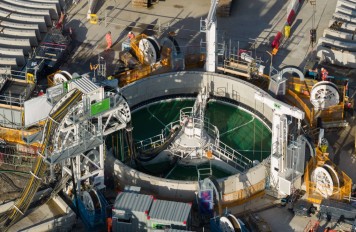
Work advances on Auckland's $260M Herne Bay wastewater tunnel

Construction is gathering pace on Auckland's NZ$260 million Herne Bay Collector, a new wastewater tunnel designed to capture wet-weather overflows before they reach Waitematā Harbour and divert them into the city's recently completed Central Interceptor.
The project, delivered for Watercare by Italian tunnelling specialist Ghella, will create a 1.7 km long, 2.1 m diameter wastewater tunnel beneath Herne Bay, connecting the local network to the northern end of the Central Interceptor. Once operational, the system will intercept wastewater and stormwater flows that currently discharge to the harbour during heavy rainfall and redirect them for treatment.
Auckland's combined wastewater and stormwater network in the area was historically designed to overflow during intense rainfall to reduce the risk of sewage backing up into homes and businesses. While this provides hydraulic relief to the network, it also means untreated flows can enter the coastal environment. The Herne Bay Collector is intended to capture more of these flows and convey them into the wider wastewater system rather than allowing them to reach the harbour.
The project includes seven main shafts, three intermediate shafts and a substantial underground control chamber beneath Point Erin Park. The chamber will extend through the equivalent of seven underground storeys. Its role will be to act as a gateway between the new collector and the Central Interceptor, regulating how wet-weather flows are transferred into the wider network.
A 56.5 m high tower crane has now been installed at Point Erin Park as construction of the chamber advances. Operating from a fixed location, the crane will lower reinforcement, formwork and other materials into the deep excavation as the structure is progressively constructed from the bottom upward. It will also handle major pipes and precast concrete elements weighing up to 24 tonnes.
Using a permanent tower crane for these operations reduces the need for repeated mobilisation of large mobile cranes around the confined site. This can improve access and construction efficiency while reducing traffic movements, noise and vibration around the surrounding residential area.
The project follows the completion of Auckland's much larger Central Interceptor, a 16.2 km, 4.5 m diameter wastewater tunnel delivered by the Ghella Abergeldie Joint Venture, which became fully operational in July 2026 after construction began in 2019. Rather than functioning as an isolated tunnel, the Herne Bay Collector will extend the reach of that new backbone system into another part of the city where wet-weather overflows remain a significant issue.
With the Central Interceptor now in service, projects such as the Herne Bay Collector represent the next stage of Auckland's wastewater upgrade. The emphasis is shifting from constructing the main underground system to connecting local catchments into it, gradually reducing the volume of untreated wastewater entering the harbour during heavy rainfall.
Sources: tunnelsandtunnelling.com, watercare.co.nz
Want to read more like this story?

Auckland’s Underground Giant Emerges After 4 Years of Tunneling
Mar, 28, 2025 | NewsOn March 28, 2025, Auckland’s most ambitious underground engineering project reached a historic mil...
Major wastewater tunnel procurement begins in southern Sweden
Jun, 02, 2026 | NewsSwedish regional water utility VA SYD has launched the procurement process for the tunnel and shaft...

Microtunnelling begins on major wastewater project in Western Sydney
Mar, 16, 2026 | NewsSydney Water has marked a major construction milestone with the launch of the first tunnel boring m...

New Zealand's first underground railway begins passenger service
Sep, 17, 2026 | NewsNew Zealand has opened its first underground railway, with Auckland's City Rail Link beginning passe...

3 major East Coast tunnel, the Hudson Tunnel, the Howard Street Tunnel and the Chesapeake Bay Bridge Tunnel, projects move forward
Jan, 11, 2022 | NewsThree major tunnel projects that connect key transportation arteries on the East Coast are advancin...
Lima completes tunnel excavation for Peru’s first fully underground metro
Jul, 20, 2026 | NewsExcavation has been completed on Lima Metro Line 2, marking a major milestone for Peru’s first fully...
India’s largest rail TBM begins tunnelling beneath Mumbai
Jul, 06, 2026 | NewsIndia’s Mumbai-Ahmedabad high-speed rail project has reached a major underground construction milest...

8 new U.S. tunnels under way: fascinating and challenging
Jan, 10, 2014 | NewsWhether you live in the U.S. or not you will find the following tunnels that are currently being bui...

California's landslide bypass tunnel moves into design
Aug, 26, 2026 | NewsCaltrans has advanced the Last Chance Grade tunnel project into detailed design, moving closer to a...
On This Day
October 16th 1882
READ MORE
Related Video

Trending

New crustal stress map of North America

Using Terzaghi’s Equation in Foundation Design

Parameters Variation: Model Customization and Sensitivity Analyses

UK geothermal projects expand from Cornwall power to Birmingham heating
Emergency ground stabilisation protects rail works near Salford Central